Part of the problem
with adaptation is the attitude of the audience, as they are usually
in some way attached personally to the project in it's original form.
Trying to make these people happy is, in my eyes, the route to
failure in some way – it would be impossible to find what everyone
enjoyed and to represent it successfully, as people are different and
they each take away their own opinion and loves/hates from the
original works. I feel the most successful adaptations are those
which take their own themes from the original to explore – there
will always be the original, so why try to remake that?
This is a quandary I'd
like to explore a little, but not too much. There are reams of
complaints regarding remakes and explanations as to why they did or
didn't work, but I would like the solution to be presented through an
adaptation that avoids these problems.
https://www.dropbox.com/s/961dcskm4tdzejz/Chapter%201.wav
The audiobook adaptation I will be working on, rights owned for the adaptation by Euan Tennant.
http://www.dagonbytes.com/thelibrary/lovecraft/theshadowoverinnsmouth.htm
A link to an online copy of the original short story, currently in the public domain.
The audiobook adaptation I will be working on, rights owned for the adaptation by Euan Tennant.
http://www.dagonbytes.com/thelibrary/lovecraft/theshadowoverinnsmouth.htm
A link to an online copy of the original short story, currently in the public domain.
The project will be a
secondary adaptation really, with the original being an audiobook
adaptation of the original short story. My ideal interpretation would
be to create something that is perfectly understandable on its own,
that is made more atmospheric by the inclusion of the audio.
Research should start
by rereading the original short story and listening to the audiobook
version before starting to look into visual styles of the work. I
have ideas in mind, artists that inspire me to move in the darker
direction that the work requires – not dark as in gory or shocking,
but dark in a much more unsettling way.
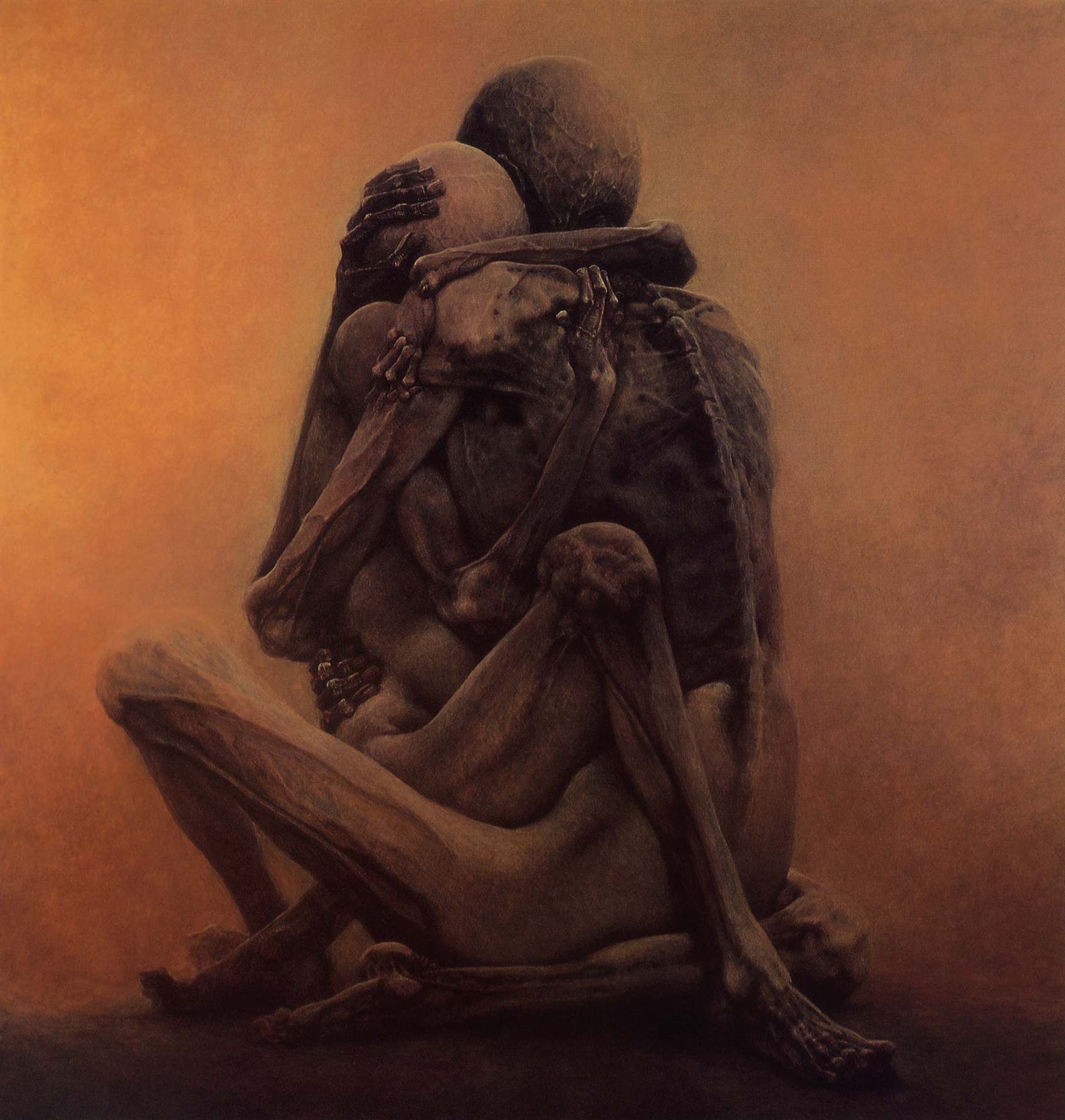 |
| Untitled Painting (1984) By Zdzislaw Beskinski |
Zdzislaw Beksisnki is a constant inspiration of mine, and I feel his unsettling art style fits this project brilliantly, after all, Lovecraft never used scenes of gore or nastiness in his work - he just used the description of the characters reaction and how it made them feel.
